

How much pocket money should children get in 2026?
What is a sensible weekly allowance in 2026? An age-by-age overview, variations by family finances, and how inflation affects the real value of your child's wallet.
The question almost always comes up before the children even start nagging: How much should we actually give? Some parents look it up in an article, others ask grandma, and a great many end up picking a number out of thin air simply because they no longer know what’s normal anymore. That’s no surprise. Weekly allowance (“ukelønn” in Norwegian) is one of the few areas of raising children where there’s little public statistics and even less consensus.
This article doesn’t try to give you a definitive answer — because there isn’t one. But we’ve gathered the best figures we have, added some practical considerations from nearly 6,000 Norwegian families who use Ukelønn, and tried to point out what actually matters when you set the amount.
What do the numbers say?
Finans Norge and SIFO (Norway’s Consumption Research Institute) have spent several years asking Norwegian parents what they give. We’ve also looked at what our own users actually register as weekly allowance in the app. Here is a pragmatic starting point for 2026:
| Age | Typical weekly allowance (kr) | Monthly (kr) |
|---|---|---|
| 6–8 years | 20–30 | 85–130 |
| 9–11 years | 40–60 | 175–260 |
| 12–14 years | 75–125 | 325–540 |
| 15–17 years | 150–250 | 650–1,085 |
All amounts on this page are in Norwegian kroner (NOK) — Ukelønn is a Norwegian app, and these figures reflect what Norwegian families actually give.
These are typical amounts, not recommended amounts. The distinction matters. A survey tells you what people do — it doesn’t tell you what’s best for your child.
Why such a wide range?
Three things explain most of the difference between families:
1. What does the allowance cover? In some families the weekly allowance covers absolutely everything the child wants on top of the essentials — cinema, sweets, clothes beyond what’s strictly necessary. In that case the amount has to be higher. In other families the allowance is purely “extra pocket money”, where the parents still buy clothes, meals out and leisure equipment. Then the amount can be considerably lower.
2. Family finances. A family with four children and one income can give less per child than a family with two children and two good incomes. That’s not unfair — it’s realism. Children notice regardless, and being honest about money is part of the lesson.
3. Expectations in return. Some families give an allowance with no strings attached. Others tie it to regular chores. When the child actually works for the money — vacuums, walks the dog, empties the dishwasher — the amount can reasonably be a bit higher. It then becomes more like a wage than a handout.
If you’re wondering what kind of chores suit different ages, we’ve written about exactly that in chores for children by age.
Inflation in 2025–2026
It’s worth reminding yourself: 50 kr in 2020 is not 50 kr in 2026. Norges Bank (Norway’s central bank) kept interest rates high throughout 2025, and consumer prices have risen steadily over the past four years. An amount you set for your child in 2022 has in practice lost 15–20% of its purchasing power.
That means two things:
- If you haven’t adjusted the allowance since 2022, your child has in reality received less each year.
- An annual adjustment of 3–5% is entirely reasonable — even if the child hasn’t “done more”.
Many families set a simple rule: on 1 January every year, everyone gets a small percentage increase. It saves you from negotiations and teaches the child that money is something that tracks developments in society.
Differentiating between siblings
This is a touchy subject. Should an 8-year-old and a 14-year-old get the same? The vast majority of families differentiate — and that isn’t unfair. It’s fair. Their needs are different.
A couple of principles that work:
- Explain the difference openly. “You get more because you’re older and need more. In three years your little brother will get what you get now.”
- Don’t lower the younger child’s amount to justify the older one’s. Each age group should have an amount that stands on its own.
- If the children have very different areas of responsibility, the meaningful basis for differentiation may be the chores, not age alone.
When is the right time to start — and to stop?
Starting: Most parents start around age 6–7, when the child can count money and understands that 10 kr is less than 20 kr. Before that, an allowance has mostly symbolic value. Some start as early as 4–5 years with very small amounts, but then it’s more about the habit than the money.
Stopping: Here there’s no right answer. Some families stop when the child gets a summer job. Others continue until 18. Some give an allowance all the way through upper secondary school, especially if the child is on a track that makes a part-time job difficult. The important thing is that you talk about it before it becomes a problem.
Vipps, cash or an app?
This too is a big change from ten years ago. Fewer than half of children under 12 receive cash today. The rest get their money via Vipps (Norway’s mobile payment app), a bank account, or an app like Ukelønn. The choice affects how the child perceives the money:
- Cash: Most tangible. Easy for the youngest to understand. Disappears fast into pockets and backpacks.
- Vipps to the child: Practical if the child has their own BankID (Norway’s national electronic ID, available from age 13), but invisible to a 7-year-old.
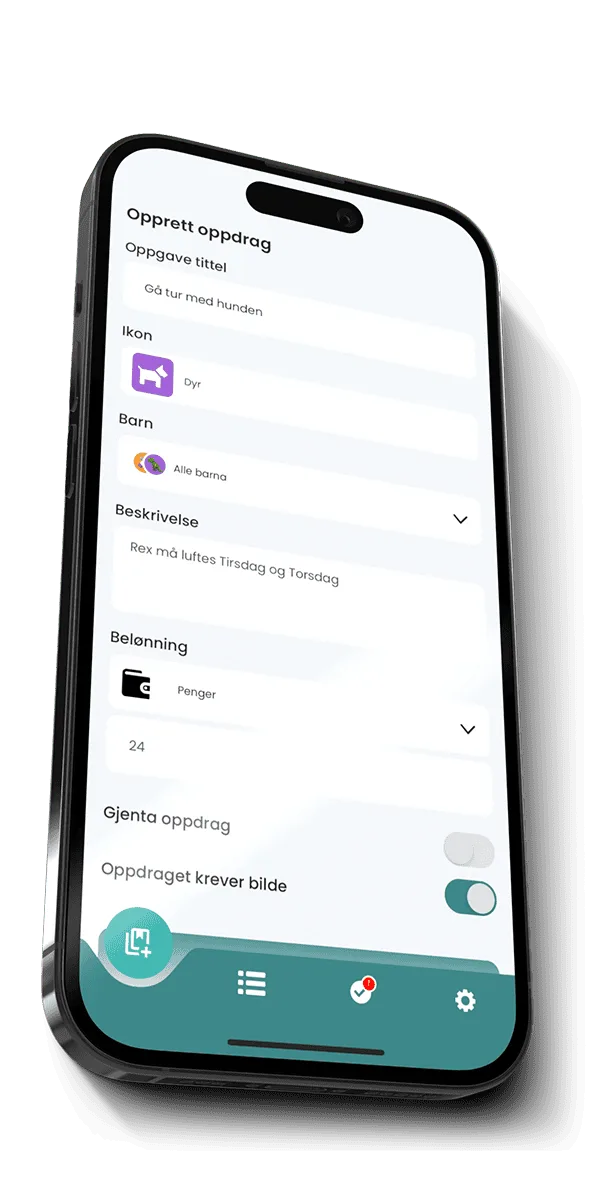
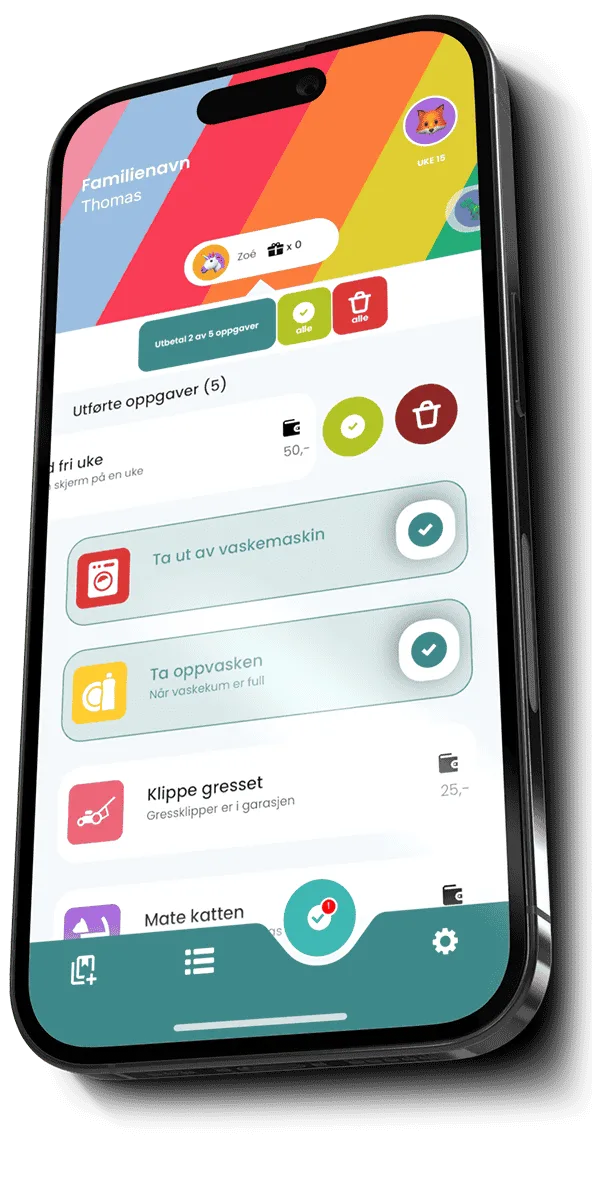
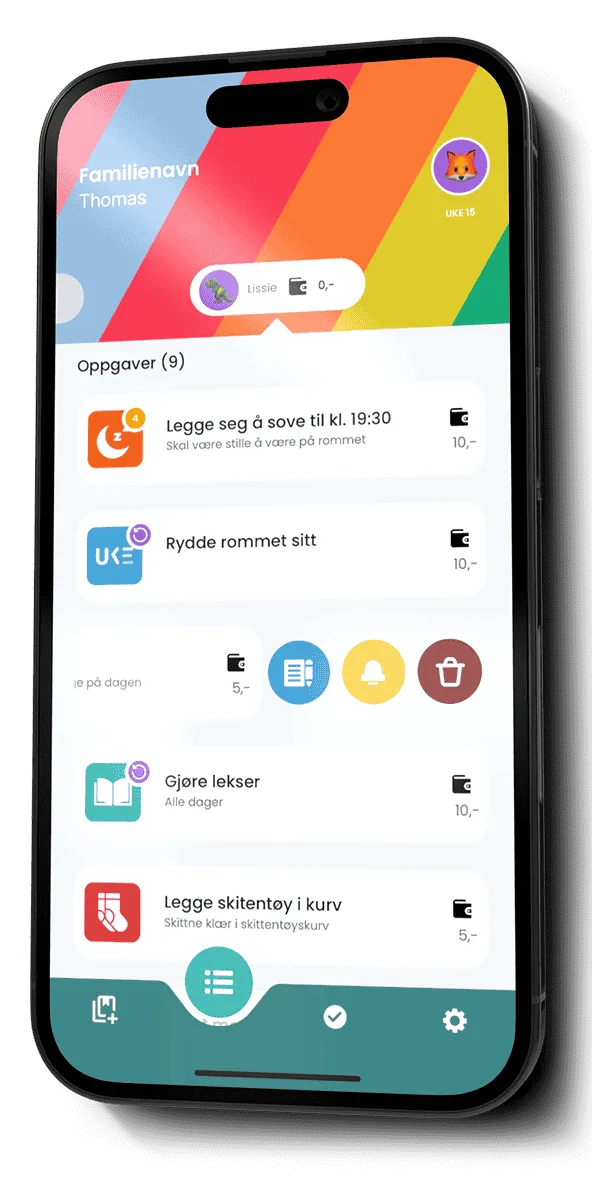
- App with a parent-controlled account: The child sees their balance, savings goals and money set aside, but the funds stay with the parents until they’re actually spent. This is the model Ukelønn uses.
None of these is right or wrong. But it’s worth thinking about what you want the child to learn — and then choosing the mechanism to match.
Frequently asked questions
Should the allowance be fixed or chore-based? Both work. A fixed amount teaches the child predictability. Chore-based teaches the connection between work and payment. Many families do both: a small base amount that arrives no matter what, and extra for chores beyond what’s expected of a family member.
Should an allowance be given if the child behaves badly? This is a quick question with a deep pedagogical answer. The short version: don’t use the allowance as punishment for general behaviour. It’s too easy to lose consistency, and the child learns that money is something that can be snatched away on an adult’s whim. If there are specific chores that weren’t done — then the pay for that chore can be withheld.
What if grandma gives 500 kr every time she visits? Talk to grandma. Seriously. It’s rarely a conversation that goes smoothly in the moment, but many families have it, and it’s worth having. One alternative is to ask that larger amounts go into the child’s savings account rather than being freely available.
Is pocket money taxable? For amounts within normal allowance levels — no. The tax-free threshold (“frikortgrensen”) in 2026 is still 70,000 kr per year, the income limit below which young people in Norway pay no tax. We’ve written more about this in tax, saving and allowance.
The amount isn’t what matters most
After watching nearly 6,000 families use Ukelønn, we’re more convinced than ever that the amount matters less than the conversation around it. A family that gives 30 kr a week and talks openly about choices, saving and priorities teaches the child more than a family that gives 100 kr and never mentions the money.
Set an amount that feels sensible for you, adjust it every year, and use it as an occasion to talk about how money actually works.
If you’d like to read more about how the amount itself can be linked to chores and responsibility, read chores for children by age or 5 habits that teach children the value of money.