

Chores for kids — an age-by-age guide
An age-by-age guide to chores and housework for children — from the 4-year-old who tidies away toys to the 16-year-old who books their own doctor's appointment.
“Can’t you just do it yourself, it’s so much faster?” Every parent has thought it. And it’s true: in the moment, vacuuming the living room yourself is faster than instructing a 7-year-old. But that’s a bit like saying it’s faster to carry your child down the stairs than to teach them to walk.
Giving children chores isn’t about getting the house tidier. It’s about letting them experience being useful members of the family — that they have something to contribute. Self-confidence isn’t built by praise from parents, but by genuine mastery of real tasks. This article goes through what research and ordinary parenting common sense say about what children can actually manage at different ages.
Principles that apply at every age
Before I get into the age groups, a few things that apply to the average child whether they’re 4 or 14:
- Don’t redo it afterwards. If your 6-year-old has folded their clothes and it looks like a mess — leave it. The child will notice you redoing it, and then she’ll stop trying.
- Instruction first, routine afterwards. First time: do it together. Second time: supervise. Third time: they do it alone.
- Be specific. “Tidy your room” is abstract. “Pick up everything on the floor and put it in the box” is concrete.
- Finish it or cancel it. A half-finished chore is worse than nothing. Better to give the child fewer tasks that they actually complete.
Ages 4–5: The small contributions
At this age the goal isn’t to get something done. The goal is to establish the identity “I’m someone who helps”. The child actually wants to — the urge for independence is strongest around age 4.
Concrete chores that work:
- Tidying their own toys into a box
- Putting dirty clothes in the laundry basket
- Feeding the pet (with a pre-measured portion, not from the 20 kg sack)
- Setting the table — forks, glasses, napkins
- Emptying the dishwasher of kitchen utensils into the drawer (not glasses!)
Duration: 2–5 minutes per task. Longer than that, and their concentration is gone.
Allowance: Most people think it’s too early to give money. Some start with a symbolic amount (5–10 kr) mostly for the habit. It’s perfectly fine to wait until age 6.
Ages 6–8: Routines start to stick
Here chores can turn into real routines. The child can read, can follow a list, and can stay focused for 10–15 minutes at a time. School has taught them to complete tasks without a parent standing beside them.
Concrete chores:
- Folding and putting away their own clothes
- Vacuuming one room (give them the easiest)
- Taking out the rubbish (if they can reach — not a requirement)
- Wiping down the kitchen counter after dinner
- Feeding and watering pets entirely on their own
- Helping to make their own packed lunch
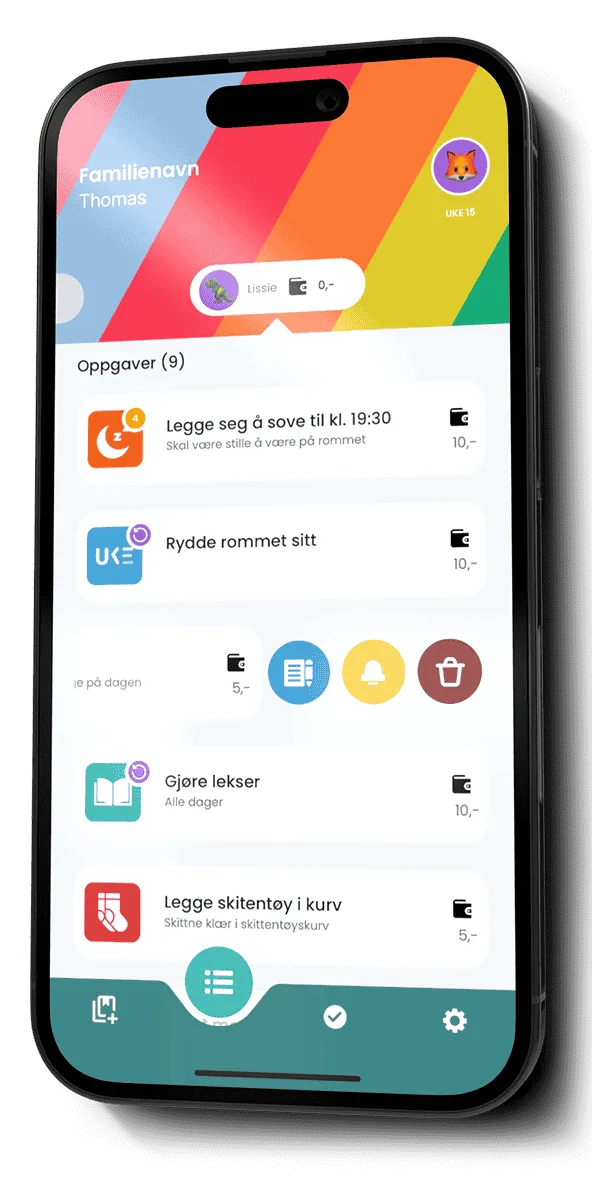
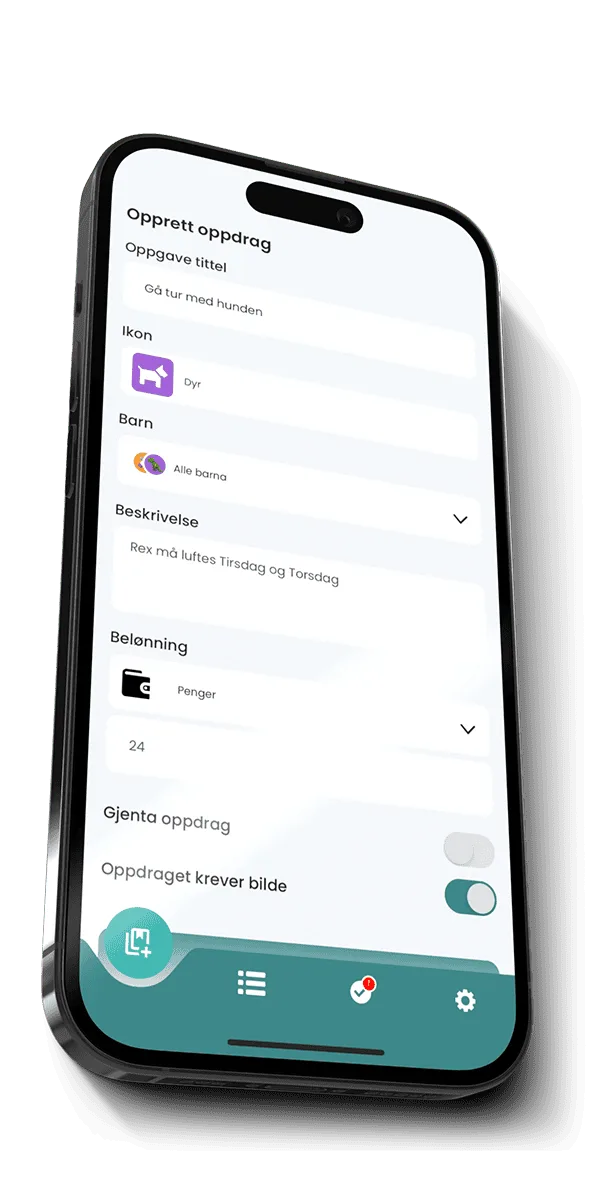
Clarity: At this age, having a list helps enormously. Our app lets children check off each individual chore — and it’s not the app that makes it work, but the fact that the list itself is a sound educational idea.
Allowance: 20–30 kr is common. More detail in how much allowance in 2026.
Ages 9–11: Independent contributions
Now the child can do things alone — from start to finish — without you needing to check in along the way. Cognitively, most are mature enough to plan a task in several steps. They can also follow a written recipe.
Concrete chores:
- Making a simple dinner (pasta with sauce, omelette, waffles)
- Washing the car on the outside
- Weeding in the garden
- Vacuuming the whole house
- Shopping at the store with a list (depending on safe routines in the neighbourhood)
- Looking after younger siblings for short periods
- Doing laundry — loading the machine, switching to the dryer, folding
Important at this age: The child starts to see unfairness clearly. If they feel siblings aren’t contributing equally — especially older siblings who get out of it — they lose motivation fast. Have the same expectations of everyone, teenagers included.
Allowance: 40–60 kr a week, ideally with extra for big tasks.
Ages 12–14: Transition to real participation
At this age chores stop being “helping out” and become “doing your share”. That’s an important linguistic and psychological shift. The child is no longer an assistant — they’re a full member of the household with expectations attached.
Concrete chores:
- Cleaning the bathroom (once they’ve shown they know how)
- Cooking dinner for the whole family once a week
- Shopping trips with independent judgement (not just a list)
- Mowing the lawn
- Changing the bed linen
- Responsibility for a fixed area (e.g. keeping the hallway tidy)
- Taking younger siblings to activities
The negotiation phase: Here the teenager gets good at negotiating. That’s healthy — but don’t give in on everything. Draw a line: basic participation isn’t negotiable. Extra paid chores are.
Allowance: 75–125 kr, often combined with extra for weekend cleaning or bigger tasks.
Ages 15–17: Preparing for life on their own
Now it’s not about helping mum and dad. It’s about the fact that in a few years your child will be living alone and managing without you behind them. If they don’t have these skills when they move out, you’ve got work to do.
Concrete chores — or rather, areas of responsibility:
- Responsibility for their own clothes — washing, hanging, folding, ironing when needed
- Booking their own doctor’s, dentist’s and hairdresser’s appointments
- Paying their own subscriptions (Spotify, Netflix account, mobile phone)
- Cooking dinner 1–2 times a week
- Keeping their own room clean without nagging
- Filling up the car if they use it
- Doing one type of cleaning of shared rooms (e.g. the kitchen every Sunday)
This is where allowance changes character. Many families switch to a larger “fixed sum” paid monthly, covering clothes, leisure activities, transport and eating out. The child then has to learn to budget — and sometimes run out of money before the month is over. That’s a lesson in itself. Better that they run out of money at 16, when they can ask mum for lunch, than at 22 when they live alone.
Allowance: 150–250 kr a week is the norm, but many switch to 600–1,000 kr a month as a “common purse”.
The hardest part: Being consistent
The biggest mistake I see in the Ukelønn statistics isn’t that parents give too little or that they have too few chores. It’s that they start with enthusiasm, are very structured for 3 weeks, and then it slides. The child doesn’t do the tasks, the parents can’t be bothered to nag, and in the end they pay out the allowance anyway because it feels mean not to.
The only thing that really works: small, but consistent. Two chores the child actually does every week, all year round, are worth more than ten chores that last until Easter.
Chores should mirror the child — not the ideal
Some children love to cook. Others hate it. Some happily tidy up. Others mow the lawn with joy. A good chore list builds on the child’s interests and abilities — not on an abstract idea of what a “good childhood” consists of. No one becomes a better person from vacuuming if they hate it. But they can become good at taking out the rubbish, and that’s just as valuable.
It all starts with one small task — and an app that makes it fun.
If you’re wondering how chores and allowance fit together financially, read how much allowance in 2026. Or take a look at 5 habits that teach kids about money if it’s the bigger picture you’re after.