

Ukelønn vs pocket money — are they the same thing?
Ukelønn (weekly allowance) and pocket money are often used interchangeably, but they actually mean different things. A look at etymology, pedagogy and everyday use.
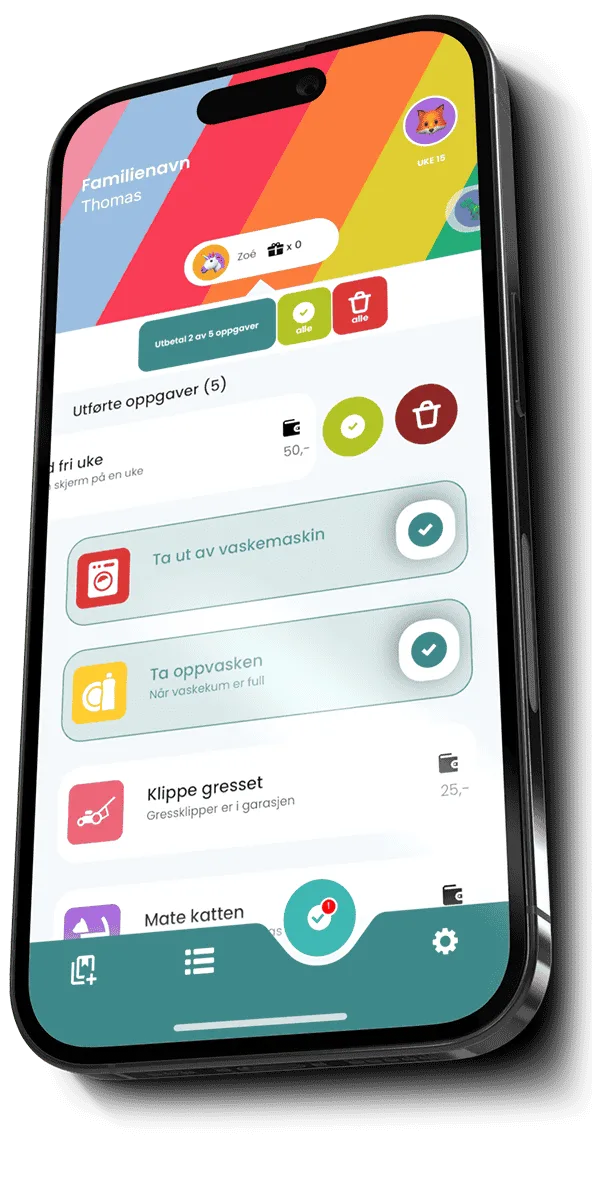
After talking to hundreds of Norwegian parents, I’ve noticed something: half of them say ukelønn (weekly allowance), half say lommepenger (pocket money), and almost none have thought about why they chose that word. That’s perfectly fine — language works that way — but the two words actually carry two rather different ways of thinking about money and children.
This is not a finger-wagging article about parenting. Nor is it an attempt to claim that one approach is better than the other. But if you know what you’re actually giving your child — and why — it becomes easier to be consistent. And consistency is what really teaches children about money, not the method you happen to choose.
What the words actually mean
Pocket money (lommepenger in Norwegian) is the older of the two terms. The word appears as early as the 1800s and literally means “money in the pocket” — money the child receives to spend freely, with no expectation of anything in return. For generations this was how children met money: from a grandfather who handed over 20 kr when he came to visit, from a mother who gave a coin for Sunday ice cream.
Ukelønn is a newer word. The key part is “lønn” — which means wage or pay. You get a wage by working. So a ukelønn is, purely linguistically, payment for work done over the course of a week. That’s a completely different deal between child and parent: you do something, you get something.
This etymological difference isn’t just academic. It mirrors two different values:
- Pocket money says: “You get this because you’re my child.”
- Ukelønn says: “You get this because you’ve contributed.”
The pedagogical distinction
The difference sounds small, but it has real consequences for what the child learns.
The pocket-money model teaches the child that money comes from relationships. That can be positive — the child understands early on that families share resources, and that you shouldn’t always tie everything to performance. It can also be negative — the child may develop the attitude that “money just appears,” without seeing its connection to work.
The ukelønn model teaches the child directly that work = money. That’s easier to carry over into adult life. But it can also create a mentality where everything has to be paid for — where the child expects a wage to take out the rubbish they created themselves, or where simple family tasks become bargaining chips.
The research here is mixed. Some studies (including one from the University of Oslo in 2018) found that children who received task-based weekly allowance developed stronger saving habits. Other studies have pointed out that children with a fixed pocket-money sum more often give to charity voluntarily — perhaps because they don’t experience the money as “my earned money.”
Neither model is a loser. Both have something going for them.
How most Norwegian families actually do it
Here’s something I’ve observed both in the Ukelønn app and in conversations with parents: even though people say “ukelønn” or “lommepenger,” the actual system in the vast majority of families is a blend.
The typical Norwegian model in 2026 looks like this:
- A base amount that comes in regularly, no matter what. In practice this is pocket money.
- Extra tasks that pay on top of that. In practice this is weekly allowance.
- Sometimes occasional bonus amounts for big jobs (washing the car, painting the fence). This is hourly pay.
It’s a fairly sensible model. The base amount says: you’re part of the family, here’s your share of what we have. The task payment says: when you put in extra effort, you get something back for it.
In our house we use both
In our family we have a small fixed sum that arrives every Friday no matter what. On top of that we have six tasks that pay a little extra if they get done — vacuuming, emptying the dishwasher, and so on. Finally we have “big jobs” that pop up now and then: washing the car, helping with garden work, clearing out the basement.
The fixed part is what they can count on. The variable part is what they can influence. The big jobs are a bonus.
It’s not the only approach that works. Some families I know do only task-based pay — no tasks, no money. Others have only a fixed pocket-money sum, with no link to chores. Both models work, and both miss the mark sometimes.
When is a purely fixed pocket money the smart choice?
For the youngest children — under 7–8 years — it’s often wiser to give a fixed pocket money with no task link. The reason is simple: cognitively, the child can’t keep track of “I got 5 kr for vacuuming, 10 kr for the rubbish, 3 kr for the toys.” It becomes noise. A fixed amount that arrives every week brings calm and lets the child concentrate on understanding the value of money — not the arithmetic.
For the oldest children — 15+ — it may also be time to go back to a fixed sum. Not as “pocket money” in the childish sense, but as a monthly common pool that the teenager budgets themselves. The task link becomes less important because the young person now has responsibility anyway, and paying for each individual chore can feel patronising.
The middle period — roughly 8 to 14 years — is where task-based weekly allowance really shines. The child is cognitively mature enough to connect work and reward, motivation rises when effort is rewarded, and the family actually gets a bit of extra help.
The choice of word shapes what the child learns
One last point: be aware of what you call it. Words create frames. If you call it ukelønn (weekly allowance), the child expects it to be something earned. If you call it pocket money, the child expects it to be something they simply get. Both expectations are valid — but you need to know what you’re signalling.
An interesting test: ask your child what they call it. What they answer often reveals more about their understanding than your intention.
It’s the conversation that counts
Whatever you land on — blend or don’t blend, call it one thing or the other — the most important thing is that you talk about it. Explain to the child why the money comes. Explain what they’re expected to do. Explain what you want them to learn.
Children who understand why they get money treat it completely differently from children who just receive it. And that holds true whether you say ukelønn, pocket money, or something else entirely.
If you want to read more about how amounts and tasks fit together, take a look at how much weekly allowance in 2026 and chores for children by age. And if you’re wondering how to use weekly allowance to teach your children about money in a bigger way, 5 habits that teach children the value of money takes it a step further.